|

|
|


|
|
|
FOR IMMEDIATE RELEASE
Contact: Carrie Lujan September 30, 2026 (661) 255-4314
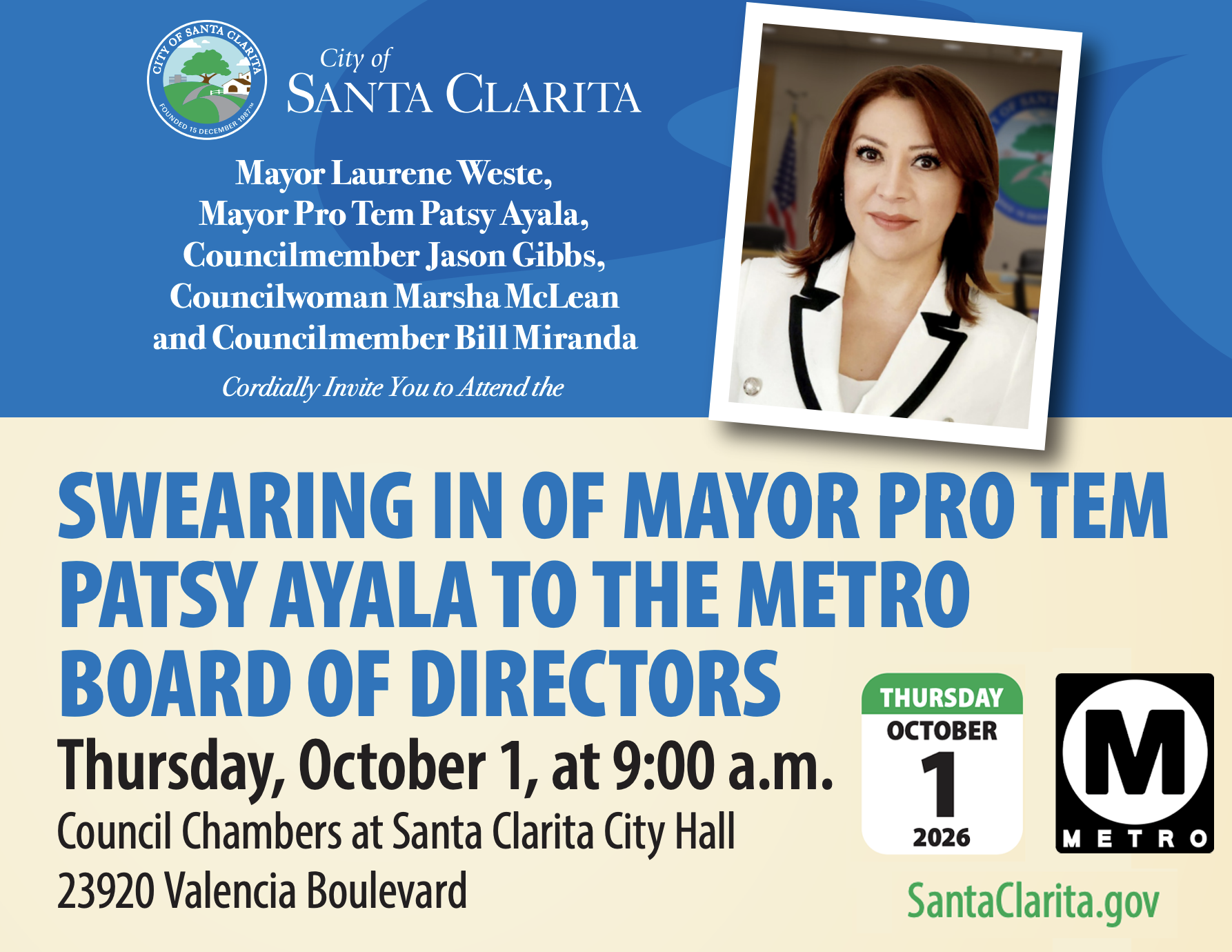
MAYOR PRO TEM PATSY AYALA SELECTED TO SERVE ON METRO BOARD OF DIRECTORS
Official Swearing-In to Take Place October 1, 2026
The City of Santa Clarita is pleased to announce that Mayor Pro Tem Patsy Ayala has been selected to serve on the Los Angeles County Metropolitan Transportation Authority (Metro) Board of Directors, bringing Santa Clarita’s and the North Los Angeles County-San Fernando Valley Subregion’s voice and perspective to the regional body responsible for shaping transportation policy and investments across Los Angeles County. A swearing-in ceremony will take place tomorrow (Thursday, October 1, 2026) at 9:00 a.m. in Council Chambers at Santa Clarita City Hall (23920 Valencia Boulevard).
Mayor Pro Tem Ayala brings more than a decade of public service and transportation policy experience at the state, regional and local levels. She currently serves as a Director of the Los Angeles County North County Transportation Coalition (NCTC), representing Santa Clarita and working alongside regional leaders to advance transportation priorities throughout North Los Angeles County.
“It is an honor to have the opportunity to represent Santa Clarita and our North County, San Fernando Valley and Malibu-Las Virgenes communities on the Metro Board,” said Mayor Pro Tem Ayala. As the third-largest city in Los Angeles County, Santa Clarita brings an important perspective to regional transportation conversations, and I am proud to bring my experience and passion for public service to this role. Transportation is ultimately about connecting people to their jobs, schools, businesses, families and communities. I look forward to working collaboratively with my fellow Board members, local leaders, businesses and transportation partners to help shape the future of transportation and strengthen connections throughout Los Angeles County.”
Prior to joining the Santa Clarita City Council, Mayor Pro Tem Ayala served in the California State Assembly and Senate, where she worked extensively on transportation legislation and initiatives. During her time in the Legislature, she collaborated with Caltrans,
Metro, Metrolink and other transportation agencies while advocating for infrastructure, mobility, safety and transportation resources for communities throughout the districts she represented.
Her experience also includes collaborating with Metro on programs designed to support businesses and communities impacted by transportation projects. This work included collaborating with the Metro’s Business Interruption Fund Program, assisting on the Metro Eat Shop Play Program and supporting transportation safety education and community outreach. Through these efforts, she worked closely with residents, businesses and regional partners to connect communities with information and resources.
A longtime Santa Clarita resident, Mayor Pro Tem Ayala has also held leadership roles with business, education and civic organizations throughout the Santa Clarita Valley. Her combination of transportation policy experience, work with the business community and collaboration across industries and levels of government will provide a broad perspective as she takes on this regional role.
“I also want to thank Ara Najarian for his many years of dedicated service on the Metro Board and for being such a strong advocate for the communities he represented,” said Mayor Pro Tem Ayala. “Ara has spent years making sure the needs of the North County and San Fernando Valley are heard, and our entire region has benefited from his leadership and commitment. I am grateful for his service and look forward to building on the strong foundation he has helped create.”
As a member of the Metro Board, Mayor Pro Tem Ayala will participate in regional discussions and decisions regarding transportation programs, policies, projects and investments affecting communities throughout Los Angeles County. She will represent the cities of Agoura Hills, Burbank, Calabasas, Glendale, Hidden Hills, La Cañada Flintridge, Lancaster, Malibu, Palmdale, San Fernando, Santa Clarita and Westlake Village. For more information on the Metro Board and its meetings, please visit BoardAgendas.metro.net.
|
|
||||
|
|
SCV Water, in partnership with the California Water Efficiency Partnership (CalWEP), is hosting this free workshop to help impacted customers better understand the new requirements and begin preparing for upcoming compliance deadlines.
The workshop will cover how the legislation applies to public agencies, HOAs, and commercial, industrial, and institutional properties, as well as resources and programs available to support customers as they prepare for compliance. A continental breakfast will be provided.
Registration is required and space is limited! We encourage you or an appropriate representative from your organization to attend.
If you have any questions about the workshop or AB 1572, please contact our Sustainability and Water Use Efficiency team at conservation@scvwa.org with the subject line NFT.
FOR IMMEDIATE RELEASE Contact: Ilyana Capellan
September 22, 2026 (661) 741-3053
SAVE THE DATE FOR LIGHT UP MAIN STREET
Celebrate the Start of the Holiday Season in Old Town Newhall
It is never too early to start planning for the most magical night of the year! Save the date for the City of Santa Clarita’s annual Light Up Main Street, presented by DrinkPAK, on Saturday, November 21, from 4:00 to 8:00 p.m. in Old Town Newhall.
Residents are invited to gather with family and friends for an evening filled with holiday cheer along five festive blocks of Main Street. Enjoy live entertainment, seasonal activities, holiday shopping, food trucks and dazzling displays as Old Town Newhall transforms into a winter wonderland.
The celebration’s centerpiece will take place at approximately 5:30 p.m., when thousands of sparkling lights illuminate Main Street during the annual tree-lighting ceremony. Guests can also look forward to 20 tons of real snow in our Snow Zone, presented by Snow Orthodontics, take holiday photos with Santa, presented by Infiniti of Valencia or write Letters to Santa, presented by The Rodriguez Agency at State Farm. There will be carnival games, holiday crafts, ice-sculpting demonstrations and so much more to interact with and enjoy.
Visitors can find one-of-a-kind gifts from local artisans at the Maker’s Marketplace, take holiday photos with sweet Therapy Dogs from Giving Paws and Alliance at Santa Paws, presented by Re/Max and explore the many restaurants, shops and businesses that make Old Town Newhall a special destination throughout the year. As the community continues to show up for Old Town Newhall following the August fire, residents are encouraged to make an evening of the celebration and support local businesses before, during and after the event.
Local nonprofits are also invited to join the festivities as North Pole Partners. Participating organizations will share their missions and highlight ways residents can give back
during the holiday season. Applications are available at OldTownNewhall.com and must be submitted by September 25. The City is also proud to partner with business sponsors Logix Federal Credit Union and Henry Mayo Newhall Hospital, adding to the festivities along Main Street.
Additional event details, including entertainment, parking and road closure information, will be announced as the event approaches. For updates, visit OldTownNewhall.com. We can’t wait to see you at this beloved City tradition!
Mental Health Hookup will host its fifth annual Stop the Stigma event on Saturday, Sept. 19 on the campus of Henry Mayo Newhall Hospital.
The event will bring together mental health professionals, advocates, service providers and community members to promote awareness, education and access to support services.
The free event is Saturday, Sept. 19, 10 a.m.-2 p.m. on the campus of Henry Mayo Newhall Hospital, 23803 McBean Parkway, Valencia, CA 91355.
Hosted annually by Mental Health Hookup, Stop the Stigma aims to raise awareness about accessible and low-cost mental health services available in the Santa Clarita Valley while encouraging open conversations about mental health and reducing the stigma often associated with seeking help.
Organizers said the event is designed to connect residents with local resources and create a supportive environment where individuals and families can learn about available services.
More than 18 organizations are expected to participate, offering information about mental health programs, support services and community resources.
Attendees can engage with a panel of experts and speakers who will share their lived experiences, connect with local service providers and enter to win a gift basket by collecting tickets from participating organizations.
The event will also feature food and refreshments, live music, family-friendly activities, raffles and giveaways.
Community members are invited to attend and connect with local organizations and advocates to learn about mental health resources and services to support a loved one or for themselves.
The event is free and open to the public.
For more information about Stop the Stigma and Mental Health Hookup, visit www.larcala.org/event-details/stop-the-stigma-2026.
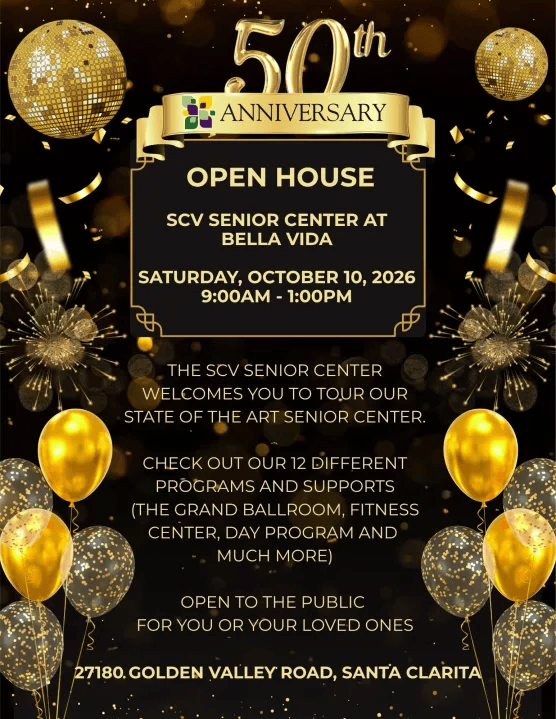
The Santa Clarita Valley Senior Center will celebrate its 50th year anniversary on Saturday, Oct. 10 with a community open house and a performance from the Santa Clarita Valley Concert Band.
The Bella Vida SCV Senior Center is located at 27180 Golden Valley Road, Santa Clarita, CA 91350.
The Santa Clarita Valley Committee on Aging was formed as private non-profit corporation in September 1976. The organization was founded on the principles of providing support and services to seniors in the Santa Clarita Valley that otherwise would not be available.
Better known as the SCV Senior Center, the organization now includes more than 12 different programs and services supporting thousands of seniors every year. It is supported by more than 110 staff members and 300-plus volunteers every month.
“The Board of Directors for the Senior Center over the years have included many of the SCV’s best and brightest. There were challenging years and some great successes,” said Christine Arnold of the SCV Senior Center.
The SCV Senior Center’s original headquarters was on Market Street adjacent to Hart Park and received the support of the county of Los Angeles for more than 40 years.
The SCV Senior Center out-grew the Market Street location and a capital campaign was launched in April 2017. The Santa Clarita Valley Committee on Aging launched the SCV Senior Center Campaign with $7.65 million raised for the $11.4 million project, including $3 million each from the city of Santa Clarita and the county of Los Angeles. The remaining $3.75 million was raised from donors to complete the project.
The Bella Vida SCV Senior Center opened in 2019. It is recognized as one of the elite senior centers in Los Angeles County.
The Saturday, Oct. 10 events include:
9 a.m.-1 p.m. Open House
This is a great opportunity to explore the SCV Senior Center programs and services and bring your loved ones who may want to check out the SCV Senior Center. This event is open to the public without reservations.
5 p.m. Santa Clarita Valley Concert Band
The Ballroom of the SCV Senior Center will host for a night of music from Santa Clarita’s best, a full 40-piece orchestra of wind instruments playing tunes from the Beatles, Stevie Wonder and more.
Tickets to the concert are $10 each. Tickets are expected to sell out. For tickets visit www.scvseniorcenter.org/events/concert-series-smooth-sounds-of-santana-647-379-725-229-952-384-934-309-615/.
For more information on the programs of the SCV Senior Center visit scvseniorcenter.org.
To assist Santa Clarita Valley residents who want to help individuals and businesses impacted by the Old Town Newhall fire, SCVTV and SCVNews.com will offer a list of vetted donation opportunities.
This list will offer information to SCV residents seeking avenues to assist the fire victims and information for fire victims on available resources.
Please remember to always check the validity of those soliciting fundraising opportunities or help after a major disaster.
BUSINESS: GoFundMe for Care and Jonny from Care Tucker Style House
STAFF: Emergency Fund for Newhall Refinery Staff
Created by an employee’s mother for the entire staff
BUSINESS: Rebuild Newhall Refinery After the August 24 Fire
Also found on their official Website: https://newhallrefinery.com/
ARTISTS: GoFundMe organized by Lauren Miscioscia to Please help artists from The MAIN Theatre recoup their gear. The MAIN is never without a show. When the theater burned, a local production of “You Got Older” was in the middle of its two-week run, having brought together many artists to design and build the show. This creative team lost many of their personal tools and equipment. They need your generous support to help them replace what was lost:
Jeremy D. Thompson is a local theater maker who devotedly and generously collaborates with productions all year long, utilizing his personal collection of equipment for multiple productions across the whole season. He lost a substantial collection of professional theatrical and production equipment, moving stage lights, lighting control gear, a full Canon camera and lens kit, power tools and miles of cabling built up over years for live production and theater work. The total estimated replacement value of everything lost is over $30,000.
Renato Biribin is an actor, writer, director, artist and theater maker who directed the last show to perform on the stage of The MAIN. He lost his personal inventory of power tools from Milwaukee valued at $2,500.
William Diament lost his Dewalt tools, stage management and set building gear, totaling $2,500.
David Stears built this theater from the ground up. He lost steel decking, platforms and moving lights, a loss of about $6,000.
To contribute to this GoFundMe visit www.gofundme.com/f/please-help-artists-from-the-main-theatre-recoup-their-gear?attribution_id=sl:037f054b-bc35-46e1-8abc-7a6da2b4fba8&lang=en_US&ts=1787729153&utm_campaign=fp_sharesheet&utm_content=amp30-control&utm_medium=customer&utm_source=copy_link.
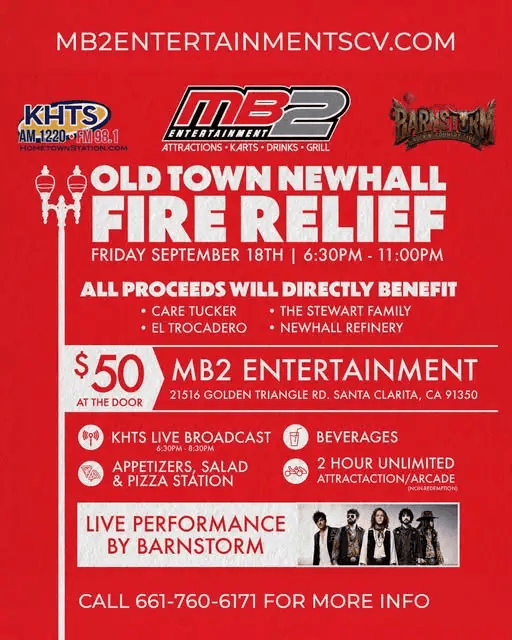
BUSINESS: MB2 Entertainment will host a fundraiser on Friday, Sept. 18, benefiting businesses affected by the fire that tore through Main Street in Old Town Newhall on Monday, Aug. 24.
The fundraiser will be held 6-11 p.m. at MB2 Entertainment, 21516 Golden Triangle Road, Santa Clarita, CA 91350.
Tickets will be $50 per person at the door, with all proceeds going to Source Inc., Care Tucker, Newhall Refinery and El Trocadero.
Admission includes the live band Barnstorm performing, a pizza, salad station and appetizers, two hours of limited attractions and two hours of unlimited arcade. Food and drinks will also be included.
COMMUNITY FUNDRAISER: Local artist Daryl Bibicoff created a piece of art of an Old Town Newhall scene to commemorate the area after the recent tragic fire that destroyed several historic buildings. Bibicoff has partnered with fellow artist, Qiana Tarlow, of Peridot Gifts, an artisan collective, to sell the shirts. The deadline to purchase a t-shirt is Wednesday, Sept. 30. All proceeds donated to affected OTN businesses. To purchase a t-shirt, visit peridotgifts.com.
Shows Scheduled at The MAIN New Venues
“Change the Station” presented by The Big Sandwich Theatre Company
It’s the 1930s, the glory days of radio. Radio dramas are thriving! Well, everywhere except Portland’s local station KOD. This run-down station is struggling to stay on the air. It’s up to Agnes, the station’s all-purpose secretary, assistant, and copywriter, to try to hold everything together and get KOD back on top! But she’ll only help rein in this cast of crazy radio stars if her boss Fred promises to make her an equal partner. Madcap comedy ensues with a wild and raucous “on-air” finale. Will the new show be a success? To find out, you better not CHANGE THE STATION. Experience the 10th Anniversary production of this original comedy written by Wade Bradford and Christopher Flowers.
25% of all ticket sales will be donated to the Santa Clarita Shakespeare Company to help cover the cost of the equipment lost in the fire.
Production Dates: Oct. 2-4
Canyon Theatre Guild, 24242 Main St., Newhall, CA 91321.
For information visit www.canyontheatre.org.
“The Velocity of Autumn” presented by HOPE Theatre Arts
Alexandra is an 80-year-old artist in a showdown with her family over where she’ll spend her remaining years. In Alexandra’s corner are her wit, her volcanic passion, and the fact that she’s barricaded herself in her Brooklyn brownstone with enough Molotov cocktails to take out the block. But her children have their own secret weapon: estranged son Chris, who returns after 20 years, crawls through Alexandra’s second-floor window and becomes the family’s unlikely mediator. No sooner are the words “Hi, Mom” uttered than the emotional bombs start detonating. THE VELOCITY OF AUTUMN is a wickedly funny and wonderfully touching discovery of the fragility and ferocity of life.
Production Dates: Oct. 9-11, 16-18
The Olive Branch Theatre. on The Patios at Valencia Town Center, 24201 Valencia Blvd., Suite #3274, Santa Clarita, CA 91355.
Tickets https://obtscv.ludus.com/show_page.php?show_id=200546219.
If you know of other offers of assistance to victims of the Old Town Newhall fire please email info@scvtv.com.
MB2 Entertainment will host a fundraiser on Friday, Sept. 18 benefiting businesses affected by the fire that tore through Main Street in Old Town Newhall on Monday, Aug. 24.
The fundraiser will be held 6-11 p.m. at MB2 Entertainment, 21516 Golden Triangle Road, Santa Clarita, CA 91350.
Tickets will be $50 per person at the door, with all proceeds going to Source Inc., Care Tucker, Newhall Refinery and El Trocadero.
Admission includes live band Barnstorm performing, a pizza, salad station and appetizers, two hours of limited attractions and two hours of unlimited arcade. Food and drinks will also be included.
Six Flags Magic Mountain has announced that Thrill Glider, a first-of-its-kind roller coaster, will debut at the Valencia theme park in 2027.
Created exclusively for Magic Mountain, the attraction combines flying, motorbike and suspended coaster technologies to establish an entirely new roller coaster category: the Thrillglider.
It will combine the freedom of flight with the intensity of a multi-launch thrill coaster, delivering an experience unlike anything guests have ever ridden.
Developed by world-renowned coaster manufacturer Vekoma for Six Flags Magic Mountain, Thrill Glider riders will board hovercycles, flying-bike vehicles, and assume a prone, face-forward position suspended beneath the track. The custom-designed, terrain-following layout encompasses 20 unique track elements and packs an action-filled 80 seconds into a dynamic aerial adventure.
Guests will launch multiple times to speeds reaching 50 mph, encounter 12 airtime moments, soar through five unique inversions (wing-over, zero-g roll, overbanked stall turn, barrel roll and upward barrel roll) and race through a dramatic station fly-by as they traverse nearly 3.5 acres.
Enhanced by synchronized onboard audio and immersive lighting effects, every moment is designed to amplify the sensation of speed, flight and freedom.
Upon opening, Thrill Glider will set a collection of records, including:
World’s First Thrillglider
World’s First Multi-Launch Thrillglider
World’s Longest Thrillglider – 3,380 feet, which is more than half a mile
World’s Fastest Thrillglider – 50 mph
World’s Tallest Thrillglider – 107 feet
Most Inversions on a Thrillglider – 5
Thrill Glider will immerse visitors in the world of QuantumPulse Propulsion Systems, a visionary technology company led by inventor and entrepreneur Rebecca Silva.
The journey begins long before takeoff in “The Futurist Pavilion,” a sleek showcase facility filled with dynamic displays, holographic presentations and scientific exhibits detailing the company’s discovery of PSR B417, a powerful new energy source with the potential to transform tomorrow.
As riders make their way through the queue, they catch glimpses of towering hexagonal collectors embedded into the hillside, harvesting energy from distant pulsars in space.
Upon entering the load station, illuminated blue energy lines, aerodynamic architecture and pulsing atmospheric audio build anticipation as riders prepare to board QuantumPulse’s latest breakthrough.
Once launched, the power of PSR B417 will be felt firsthand as the vehicles soar above the landscape through sweeping maneuvers, sudden dives and weightless moments that simulate piloting a high-speed hovercycle powered by tomorrow’s technology.
lending engaging storytelling, futuristic design and advanced coaster technology, Thrill Glider delivers a one-of-a-kind adventure that transports guests into an optimistic vision of the future.
“Thrill Glider is more than a new attraction. It is the latest milestone in Six Flags Magic Mountain’s renaissance and a reflection of the park’s enduring role as an industry innovator,” said Brian Oerding, park president of Six Flags Magic Mountain. “With a decades-long reputation for introducing record-breaking attractions and genre-defining rides, Magic Mountain is uniquely positioned to pioneer an entirely new coaster category and bring Thrill Glider to life.”
At Magic Mountain, excitement isn’t defined by a single measurement. For some guests, that means chasing record-breaking speeds and inversions. For others, it’s the feeling of soaring through the air, experiencing weightlessness for the first time or sharing an unforgettable ride with family and friends.
As the park continues to evolve, it is introducing attractions that appeal to a wider range of guests while maintaining its reputation as the Thrill Capital of the World.
Thrill Glider represents that vision, delivering a new kind of excitement that makes the sensation of flight accessible to more riders than ever before.
With a minimum height requirement of just 48 inches, Thrill Glider will be open to a broad range of thrill seekers, from families and first-time coaster riders to dedicated enthusiasts.
Thrill Glider will be located on the former site of the Golden Bear Theatre between Full Throttle and LEX LUTHOR: Drop of Doom and adjacent to the recently reimagined Looney Tunes Land.
The ride is already under construction and is scheduled to open in 2027. Additional details and opening information will be announced at a later date.
Guests can lock in their seat to be one of the first to ride Thrill Glider with a 2027 Season Pass, available now. The lowest price of the season was recently extended and is available through Sept. 13, allowing unlimited flights in 2027, as well as park access for the remainder of 2026.
Guests can begin the countdown today and watch as Thrill Glider takes shape while also enjoying this year’s Fright Fest, Tricks and Treats and Holiday in the Park seasonal celebrations.
Passholders also receive regional access to multiple parks across the West Coast, including Knott’s Berry Farm featuring the newly opened MonteZOOMa: The Forbidden Fortress and the park’s Halloween celebrations, Knott’s Scary Farm.
For more information on 2027 Season Passes or to plan your visit to Magic Mountain, visit sixflags.com/magicmountain.
Six Flags Magic Mountain, known as the Thrill Capital of the World, is home to world-class roller coasters including icons such as Twisted Colossus, Tatsu, Goliath and Full Throttle. Thrill seekers of all ages can enjoy various events and entertainment plus over 100 games and attractions.
For more information, visit sixflags.com/magicmountain or follow on Instagram, Facebook, TikTok, X, YouTube and LinkedIn. #ThrillCapitaloftheWorld.
Contact: Ilyana Capellan
(661) 741-3053
SHOW UP FOR OLD TOWN NEWHALL
Final SENSES Block Party of the Season to Honor Businesses Lost in Old Town Newhall Fire
The City of Santa Clarita invites residents to show up for Old Town Newhall and support ongoing fire recovery efforts at SENSES Block Party on Thursday, September 17, from 7:00 to 10:00 p.m. on Main Street. The event will bring the community together following the devastating fire that destroyed beloved Old Town Newhall businesses.
On the morning of Monday, August 24, a devastating fire engulfed several structures in Old Town Newhall, including Newhall Refinery, Care Tucker Style House and The MAIN. The loss extends far beyond the buildings themselves, deeply impacting the business owners, employees, artists and community members who brought these spaces to life. Now, the community is coming together to Show Up for Old Town Newhall.
Show Up for Old Town Newhall during this special SENSES Block Party and support the businesses, employees and artists affected by the recent fire. SENSES will extend further down Main Street to Hart & Main, creating additional opportunities for the community to come together. A Community Art Wall near the site of the fire will invite guests to color illustrations honoring the impacted businesses and leave messages of support. An outdoor silent auction will also be open to everyone attending SENSES, with donated baskets and artwork benefiting those affected by the fire. Guests can continue showing up for Old Town Newhall at Love on Main, a separate ticketed event taking place at Hart & Main during SENSES. The benefit will feature live music, food and drinks, with proceeds supporting members of the Old Town Newhall community impacted by the fire. Tickets are required for Love on Main and can be purchased through Eventbrite.
The evening will continue with SENSES Oktoberfest-themed entertainment and activities throughout Main Street. Dance to live music from Die Sauerkrauts, admire a lineup of classic Volkswagen cars or test your skills with barrel racing, barrel bowling, carnival games and a stein-holding competition. Guests can also create pretzel necklaces, enjoy savory bites from FryDay and grab a sweet treat from LA Donut. Old Town Junction will serve drinks at the on-street bar throughout the evening.
The City is also excited to expand its Open Rewards program to Old Town Newhall, giving residents another way to support local businesses beyond SENSES. Open Rewards is a free cashback program available at participating businesses, allowing customers to earn 5% cash back on eligible purchases. Getting started is simple – download the Open Rewards app, create a free account and securely link a credit or debit card to automatically earn cash back when shopping at participating businesses. Residents who prefer not to link a card can still participate by uploading eligible receipts through the app. For more information about the Open Rewards program, visit ThinkSantaClarita.com/Open-Rewards.
So, come out and Show Up for Old Town Newhall on Thursday, September 17, 2026. For more information, visit OldTownNewhall.com.
Contact: Joe Redmond
(661) 286-4063
GROW YOUR BUSINESS WITH GOOGLE AND AI
Free Workshop Helps Local Businesses Put AI-Powered Tools to Work
The City of Santa Clarita invites local business owners, entrepreneurs and professionals to discover practical ways to use artificial intelligence during the free Grow with Google: Make AI Work for Your Business workshop on Tuesday, September 22, from 10:00 to 11:00 a.m. at the Canyon Country Community Center (18410 Sierra Highway) in the Grand Room.
Designed to help businesses make the most of today’s digital tools, the workshop will explore how AI-powered Google resources can help save time, connect with customers and support business growth. Participants will learn practical strategies they can begin applying to their businesses right away.
Whether you own an established local business, are building a new one or simply want to strengthen your digital skills, this free workshop provides an opportunity to learn how emerging technology can support your goals and help your business thrive.
To register, please visit City.SC/GrowWithGoogleSeminar. For more information, contact the Economic Development office at EconDevInfo@santaclarita.gov or by phone at (661) 255-4347.
When legal documents need to be served, choosing the right process server can make an important difference. Attorneys, law firms, businesses, landlords and individuals throughout Santa Clarita and Valencia rely on professional process servers to properly deliver legal documents and provide clear documentation of each service attempt.
The Process Server Agency, LLC is a locally based process serving company serving the Santa Clarita Valley and surrounding communities. We handle a wide variety of legal documents, including subpoenas, summons and complaints, small claims documents, family law documents, restraining orders, eviction notices and other civil process.
Serving legal documents involves more than simply going to an address and knocking on a door.
Accurate documentation can be especially important when questions arise about when or where an attempt occurred. At The Process Server Agency, our service attempts include GPS, date and time-stamped photographic documentation, providing clients with additional information regarding each attempt.
We also provide detailed status updates so clients know what is happening with their assignment rather than being left wondering whether an attempt has been made.
Working with a process server familiar with Santa Clarita, Valencia and the surrounding area can provide an advantage.
Knowledge of local neighborhoods, gated communities, apartment complexes, businesses and traffic patterns can help a process server plan attempts more efficiently and determine appropriate times to attempt service.
Our standard service generally includes up to three attempts, with attempts made at varying times when appropriate to increase the likelihood of reaching the individual being served.
Some documents require additional urgency.
Restraining orders, subpoenas, hearing notices and other time-sensitive documents may have approaching court dates or statutory deadlines. When selecting a process server, clients should clearly communicate upcoming deadlines so the server can determine whether routine, rush or same-day service may be appropriate.
Restraining-order assignments can also involve unique safety considerations. Our agency reviews these assignments carefully and may speak with the client before service to obtain information about the restrained individual and any known safety concerns.
One of the simplest ways clients can improve the chances of successful service is by providing as much information as possible.
In addition to the service address, helpful information can include a physical description, photograph, vehicle description, employer information, known schedules or other locations where the individual may be found.
The more useful information available to the process server, the better prepared the server can be when making an attempt.
When hiring a process server, consider more than price alone. Ask how many attempts are included, how attempts are documented, how status updates are provided and what happens if the individual cannot be located or served.
Clear communication and thorough documentation are important parts of professional process serving.
The Process Server Agency, LLC is proud to be a member of the Santa Clarita Valley Chamber of Commerce and to serve attorneys, businesses and residents throughout Santa Clarita, Valencia and the surrounding communities.
For additional information about our process serving services, pricing or submitting documents for service, visit OrderToAppear.com.
By City Manager Ken Striplin
Old Town Newhall has always been more than a destination. It is a place where neighbors gather, families make memories and local businesses pour their time, energy and dreams into creating something special for our community.
The fire that swept through Main Street early Monday, August 24, was devastating for the businesses that help make Old Town Newhall our premier Arts and Entertainment District. Business owners lost spaces they had invested years of hard work, passion and resources into building, while employees lost workplaces and customers lost businesses that had become part of their lives. In the weeks since the fire, our focus has been on supporting those affected, helping our businesses move toward recovery and making it clear that the City will remain a committed partner as they rebuild and move forward. For more information on how to support these businesses, please visit OldTownNewhall.com.
The loss of The MAIN has been especially difficult. More than a theater, The MAIN was a creative home where local artists performed, audiences connected and our community came together to experience live theater, music, comedy and the arts. It was also a place where City staff dedicated themselves to the arts, working behind the scenes to create opportunities for artists and memorable experiences for our residents.
We are working to ensure Old Town Newhall remains active and welcoming in the months ahead. On September 17, the SENSES Block Party will bring the community back to Main Street for an evening of music, entertainment and connection. This month, the City is partnering with the Old Town Newhall Association to expand SENSES an additional block to the south and incorporate activities supporting fire recovery efforts.
One of the most important things each of us can do right now is show up for one another. Visit Main Street, shop at a local business or grab a meal at one of its restaurants. Supporting the retailers, restaurants and entrepreneurs who give this historic district its unique character has never been more important. Every visit and every purchase are reminders that our community stands behind our neighbors who were affected by this fire.
There is a long road of healing and rebuilding ahead, but Santa Clarita has never been a community that faces challenges alone. Together, our community will support one another through the recovery and help ensure Old Town Newhall remains a vibrant destination for arts, entertainment, dining and community gatherings for years to come.
Ken Striplin is the City Manager for the City of Santa Clarita and can be reached at kstriplin@santaclarita.gov.
Why a thriving business and a clear personal financial plan are two different things.
By Tyler Tilton, CFP®, CRPS®, CEPA®, Partner at Vance Wealth
Last year we met a business owner who had built something remarkable.
Years of early mornings, late nights and decisions that put the company first had grown the business well past what they first imagined. Revenue was strong. The team was busy. The business had real value. And the life they had hoped the business would create still felt out of reach.
The home they wanted to buy raised new questions. Their compensation had not kept pace with the role they were actually playing. Family ownership structures that made sense years earlier had become complicated. Profits were sitting inside the corporation, creating tax concerns without moving the family any closer to their goals.
We see this pattern more often than people realize.
A business can be successful on paper while the owner's personal financial picture still feels unclear. Usually it isn't because the business plan or the personal plan is broken. It's because the two have drifted apart. That gap grows slowly, then gets felt all at once.
"Business owners are often so focused on growing the company that their personal financial life gets left behind. Our job is to close that gap, so the success they've created actually shows up in their life."
Where the gap usually shows up first
If you own a business, the drift rarely announces itself. It tends to surface in a handful of familiar places:
What closing the gap actually looks like
The work isn't flashy, but it matters. For this owner, it meant coordinating with their attorney and accountant, revisiting compensation, reviewing ownership structures, evaluating asset protection strategies and making sure tax planning supported both the business and the family's long-term goals.
Working steadily according to that plan, they eventually bought the home and eased their tax burden. They found a personal and professional alignment they didn't have before. And they finally started to enjoy some of the success they had worked so hard to build.
Questions worth asking this quarter:
Even without a formal review, these four questions tend to reveal how far the two plans have drifted:
A cohesive plan brings clarity to compensation, taxes, ownership, protection and long-term planning, so the success inside the business better supports the life outside of it.
After all, the business was never meant to become your whole life. It was meant to help build one.
Vance Wealth is a wealth management firm serving business owners and families, with offices in Santa Clarita and Costa Mesa. Learn more at VanceWealth.com.
The client situations referenced above have been anonymized to protect privacy.
The information provided is for educational and informational purposes only and does not constitute investment advice and should not be relied upon as such. It should not be considered a solicitation to buy or an offer to sell a security. It does not take into account any investor's particular objectives, strategies, tax status or investment horizon. Consult your attorney or tax advisor regarding your individual situation.
This plan should not be considered tax advice. Clients should consult with a qualified tax consultant as to their particular situation and to discuss potential tax consequences.
Certified Financial Planner Board of Standards, Inc. (CFP Board) owns the CFP Certification mark, the CERTIFIED FINANCIAL PLANNER certification mark, and the CFP certification mark (with plaque design) logo in the United States, which it authorizes use of by individuals who successfully complete CFP Board's initial and ongoing certification requirements.
Get certified, get connected, get contracted
September 24, 2026 - September 24, 2026
Outreach , Workshops in 3355 E Gage Ave., Huntington Park, CA 90255
Attend this workshop to understand government contracting process from the ground up. Learn practical guidance on certification requirements, financial readiness, and procurement opportunities.
Thursday, September 24
10 a.m. – 2 p.m.
3355 E Gage Ave Huntington Park, CA 90255
Event takeaways:
Hosted by New Economics for Women Women's Business Center
Contact
Ruth Garcia-Corrales