
If you checked your investment statements this fall and wondered why your "safe" bonds were down, you are not alone. Rising interest rates pushed bond prices lower across the market in 2026. For business owners, that matters twice: once in your personal portfolio, and again in any company retirement plan, cash reserve, or buy and sell agreement funding you have set aside.
The good news is that this has happened before, and history offers a useful roadmap for what comes next.
What happened
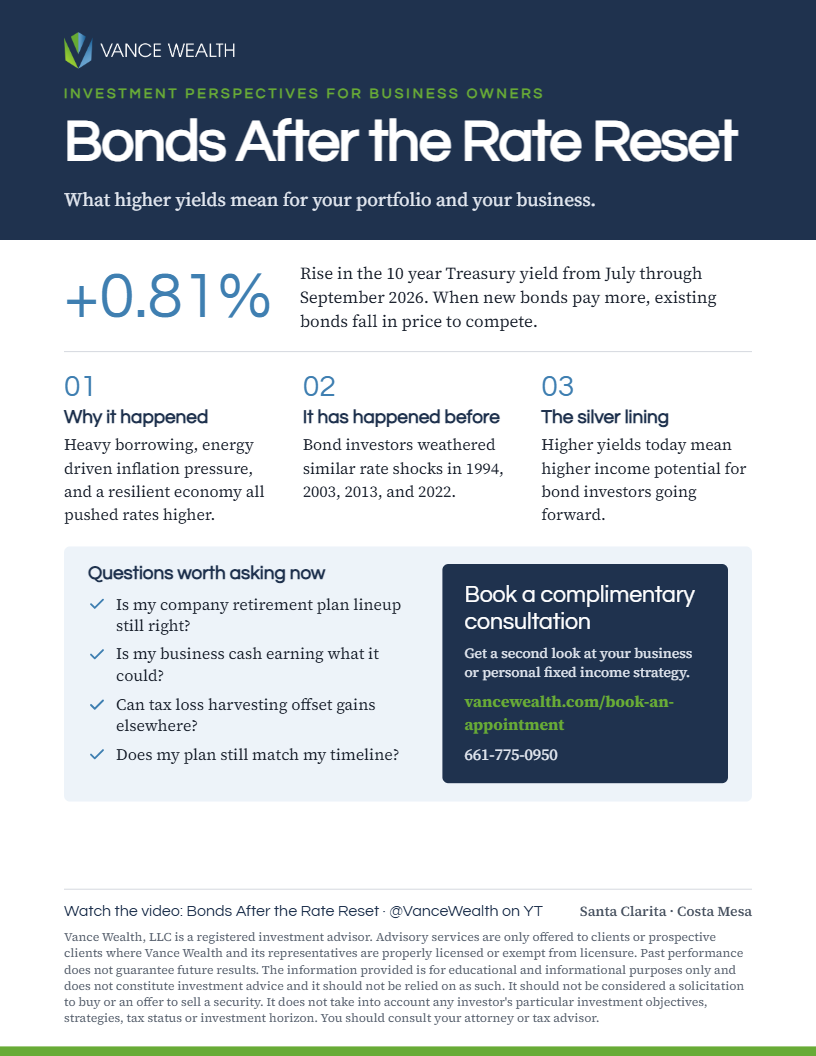
Treasury yields rose sharply in 2026. The 10 year Treasury yield alone climbed 81 basis points (0.81%) from July through September.
Here is why that hurts existing bonds. When new bonds come to market paying higher interest, older bonds paying less become less attractive. Their prices fall until their yield is competitive. That price drop is what many bond investors have felt on their statements this fall.
Why it happened
Three forces pushed rates higher at the same time:
- Heavy borrowing. Both the government and corporations issued large amounts of debt, and more supply means lenders can demand higher rates.
- Inflation pressure. Energy disruptions kept prices elevated, and investors want a higher yield to stay ahead of inflation.
- A resilient economy. Steady growth reduced the odds of near term rate cuts, so yields stayed elevated.
If you run a business, you have likely felt the same forces in your borrowing costs, your energy bills, and your customer demand.
This has happened before
Rate shocks are uncomfortable, but they are not new. Bond investors have weathered several in the past three decades:
|
Year |
What drove it |
|---|---|
|
2022 to 2023 |
Fastest Federal Reserve hiking cycle in decades, followed by a surge in long term yields |
|
2013 |
The "taper tantrum," when the Fed signaled it would slow bond purchases |
|
2003 |
A sharp summer selloff as the economy recovered |
|
1994 |
Surprise Fed rate hikes that caught markets off guard |
What followed matters most. Over time, a bond's return depends largely on the yield it pays. A selloff lowers prices today, but it also resets yields higher, which raises the income bonds can earn going forward. In past episodes, that higher starting yield helped bond investors recover in the years that followed.
What it means for business owners
A few questions worth asking now:
- Is your company retirement plan lineup still right for your team? Rising rates are a good prompt to review the bond options in your 401(k) and how employees are using them.
- Is your business cash earning what it could? Higher short term yields mean reserves sitting in a low rate account may be leaving income on the table.
- Can losses work for you? If bonds in a taxable account are down, tax loss harvesting may let you offset gains elsewhere while staying invested.
- Does your plan still match your timeline? A temporary price drop matters less if you do not need the money soon, and more if a sale, succession, or major purchase is near.
The biggest risk is usually reacting to the headline. Selling bonds after prices have fallen locks in the loss and gives up the higher income ahead.
About Vance Wealth
Vance Wealth is a wealth management firm with offices in Santa Clarita and Costa Mesa, California, helping individuals, families, and business owners plan with clarity and confidence.
Although bonds generally present less short-term risk and volatility risk than stocks, bonds contain interest rate risks; the risk of issuer default; issuer credit risk; liquidity risk; and inflation risk.